
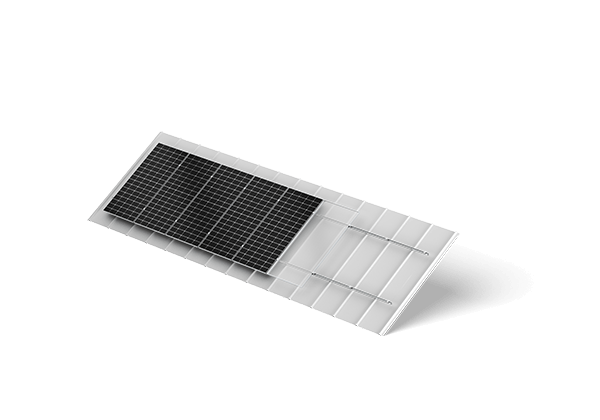
Metal-roof photovoltaic systems often use either direct-fix clamps that connect modules close to the roof profile or shared rails that create a continuous support line above multiple attachments. The choice changes the number of interfaces, adjustment range, thermal behavior, material volume, and inspection process.
Selecting roof solar panel mounting brackets begins with the exact roof construction and its allowable connection method. Antaisolar supplies mounting options for varied roof types, but the building engineer, roofing provider, and system designer still need to agree on where loads enter the structure and how weather protection is preserved.
Matching the Attachment to the Roof Profile
Standing-seam roofs may accept nonpenetrating clamps when seam geometry, material, coating, and seam-forming method are compatible with tested hardware. Trapezoidal or corrugated sheets may require fasteners into purlins or approved sheet connections. Tiles usually need hooks or replacement components that transfer load without bearing improperly on brittle surfaces.
Direct-fix arrangements reduce the distance between module and roof, which can limit lever arms and material use. They also make the roof’s dimensional variation immediately relevant to module alignment. Brackets need enough adjustment to accommodate realistic construction tolerances without leaving fasteners at the edge of slots.
Shared rails can bridge between attachments and create a more forgiving plane for module installation. That benefit comes with rail bending, splice, cantilever, thermal expansion, transport, and bonding considerations. Designers should avoid assuming that a continuous rail automatically distributes loads equally among supports.
Antaisolar’s rooftop range combines roof-specific interfaces with lightweight aluminum components. Relevant 6A22-T6 parts are reported to have tensile strength of 300–335 MPa and yield strength of 285–310 MPa. Those values should be verified alongside section geometry and connection capacity for the purchased assembly.
Managing Movement, Drainage, and Installation Tolerance
Temperature cycles cause modules, rails, metal sheets, and supporting structures to expand at different rates. Long rails need defined expansion joints and splice behavior, while direct-fix systems require sufficient freedom or engineered restraint at module connections. Unplanned binding can load fasteners, distort frames, or stress roof seams.
Water management deserves equal attention. Penetrations require compatible seals, correct compression, clean surfaces, and installation conditions within the sealant or gasket limits. Nonpenetrating clamps should not deform seams in a way that compromises drainage or coating integrity. Every layout must keep primary water paths and roof drains clear.
Field tolerances determine whether an elegant detail remains practical at scale. Survey data should capture rib spacing, seam variation, purlin location, roof steps, and obstructions before finalizing quantities. A representative mockup can expose conflicts between bracket adjustment, module clamp zones, cable routing, and required edge distances.
Antaisolar’s SnapFit approach uses click-in engagement and retained elements to support one-handed work, and the company reports installation-efficiency gains above 50 percent. Such features can reduce repetitive motions, although the contractor’s trial should include layout, fastening, torque verification, and correction time rather than timing only the clamp engagement.
Selecting the System Through Project Evidence
Reliable sourcing compares tested assemblies, not generic component labels. Documentation should identify the roof profile, sheet thickness, seam or fastener type, module frame, load direction, edge distance, installation torque, and failure mode used in testing. Extrapolation beyond tested limits needs a defensible engineering method.
Structural calculations should report reactions at each connection and confirm the supporting deck, purlin, rafter, or slab. Wind zones near corners and edges often require closer attachment spacing than interior areas. Snow drifting, seismic movement, maintenance access, and temporary construction loads may also control portions of the roof.
Procurement reviews can compare total installed cost through bills of material, freight volume, rooftop handling, tools, crew productivity, inspection, and expected waste. The preferred roof solar panel mounting brackets are those that meet the building’s technical constraints while giving installers a repeatable and inspectable sequence.
Antaisolar supports roof projects with engineering, logistics, installation guidance, and warranty coverage for eligible systems. A final decision should document interface ownership among the mounting supplier, roofer, structural engineer, module provider, and contractor so that gaps are resolved before work reaches the roof.