
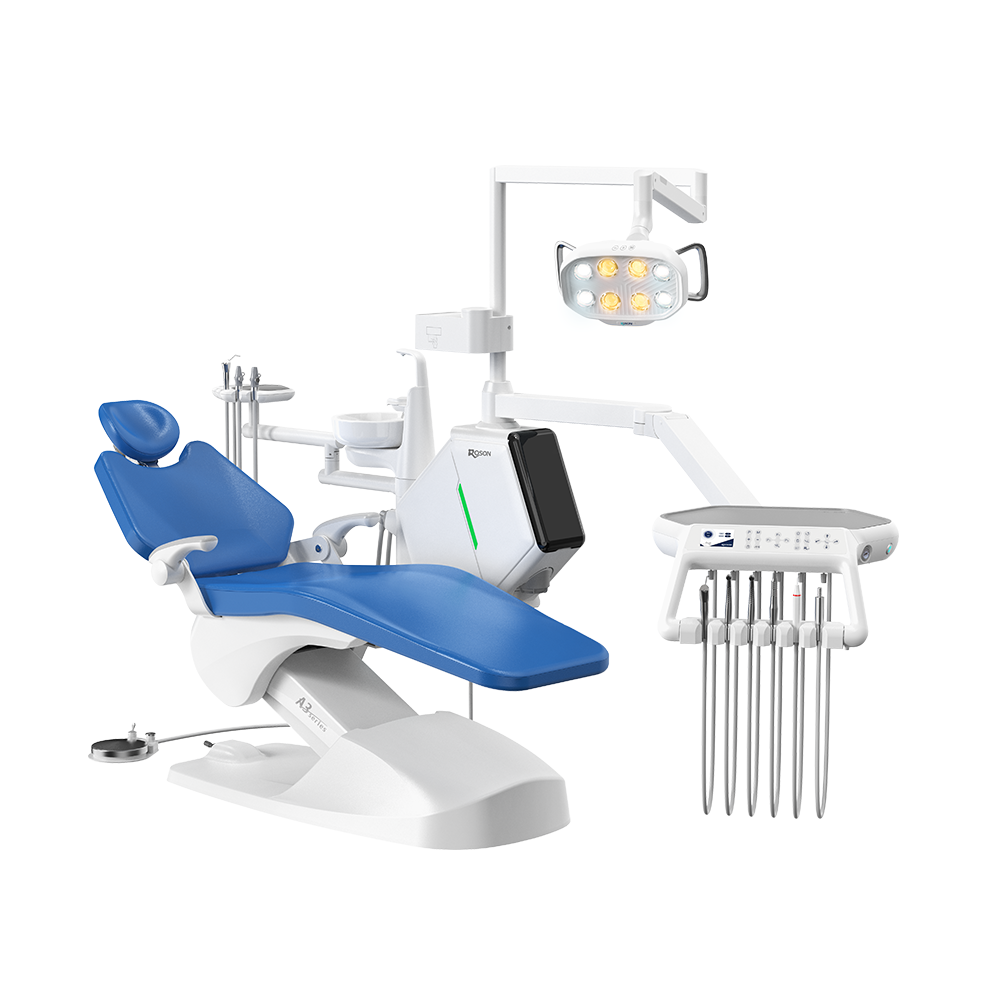
Dentists considering a new treatment room often face a deceptively simple question: does buying a dental unit manufactured in China make financial sense? The answer cannot be determined from the country of origin alone.
A worthwhile investment depends on what the equipment includes, how closely its configuration matches the practice, and what support is documented after purchase.
That makes dental unit China a purchasing question rather than a geographic one. Instead of assuming that lower or higher cost equals better value, dentists can assess the equipment according to its functions, configuration, maintenance features, and stated warranty terms.
A Country Label Cannot Tell Dentists Whether the Investment Is Worth It
Manufacturing location does not, by itself, reveal whether a particular treatment unit will suit a dental practice. Two products made in the same country can have very different configurations, components, controls, and service arrangements.
A more useful evaluation begins with the specification sheet. Roson’s A3, for example, lists an ergonomic design, configurable handpiece placement, a medical-grade color LCD interface, three customizable chair memory positions, and several integrated operating functions.
That distinction matters because dentists are not really investing in a country. They are investing in a clinical workstation that must support their daily procedures. The relevant question is therefore whether the proposed equipment provides functions that will actually be used.
The Real Test Is What the Unit Does During a Working Day
Daily workflow reveals the practical value of dental units more clearly than a product description alone.
The A3 includes a startup self-check function and error-code display, giving operators information about the unit’s operating status and potential troubleshooting needs. Its handpiece holder can also be adjusted across four angles from 30° to 80°, allowing positioning to be adapted to the operator.
Water management provides another example. The model offers dual infrared and gravity sensing for automatic cup-water dispensing, while its one-key intelligent drainage function raises the chair and initiates a five-minute spittoon flushing cycle.
Features such as these do not automatically make a unit a better investment. Their value depends on whether they solve real workflow requirements in the intended practice. A dentist who prioritizes simplified daily cleaning may value integrated drainage differently from one whose purchasing priority is a particular handpiece configuration.
Customization Changes the Calculation
A dental unit China purchase should not be evaluated from the base model name alone. Configuration can change what the dentist receives and, consequently, what the purchase is worth.
The A3 offers three handpiece placement formats: over-the-patient, swing-mounted, and cart-mounted. It also provides choices involving upholstery and unit color, while built-in scalers and electric motors are identified as optional equipment.
That flexibility can make a purchase more closely aligned with the operator’s preferred workflow. It also creates a practical procurement question: which options are genuinely required?
Paying for an elaborate configuration that does not improve the intended workflow may reduce value. Conversely, selecting a minimally equipped system when the practice needs integrated instruments can lead to additional expenditure later.
Maintenance Features Can Affect Long-Term Value
Investment value is also shaped by what happens after installation. Equipment that provides functions supporting routine cleaning and diagnosis can influence how conveniently staff manage the treatment room.
The A3’s smart drainage function is specifically designed around end-of-day cleaning, while its LCD interface provides operating information and error-code display. The model also offers an advanced micro-electrolysis disinfection system described by the manufacturer as supporting biofilm prevention and water-system disinfection.
Such features should be assessed according to documented specifications rather than assumed performance. Dentists can ask how each function operates, what routine procedures remain necessary, and whether the feature is included in the quoted configuration.
This is where the evaluation of dental units becomes more practical. A useful investment is not simply one with numerous features; it is one whose features correspond to the clinic’s actual operating routine.
Warranty Details Give the Purchase More Context
Price comparisons can become misleading if warranty coverage is ignored. A lower initial quotation may look attractive until the buyer discovers that important components have limited coverage or that the supplied configuration differs between quotations.
For the A3, the manufacturer states five-year warranty coverage for its water and air pipelines, breathable seamless microfiber leather, and TIMOTION motor. The listed RoLight dental light carries a three-year warranty.
Those published terms give buyers something concrete to examine, but warranty duration should not be treated as a substitute for reviewing the actual warranty conditions. Coverage, exclusions, parts availability, technical assistance, and the process for handling faults all deserve clarification before an order is placed.
For an overseas buyer, those details are especially relevant because the practical ownership experience depends on more than the equipment’s purchase price.
So, Should Dentists Buy From China?
A dental unit China purchase can be worth the investment when the specific product offers an appropriate configuration, useful workflow functions, documented maintenance features, and clearly defined warranty coverage.
The A3 provides a concrete example of why the decision should be specification-led. Its published information identifies configurable handpiece arrangements, integrated control functions, water-management features, cleaning-oriented functions, optional equipment, and stated warranty periods.
Instead of using national origin as a final verdict, Roson provides a model for evaluating equipment based on its actual performance. This same principle should anchor any objective supplier comparison.
Dentists should ask a narrower and more useful question: does the quoted unit provide the functions, configuration, ownership support, and documented coverage that justify its cost for the intended practice? If the answer is yes, buying from China can be a rational equipment investment; if the specification does not fit the clinic, an attractive price alone is unlikely to make it worthwhile.