
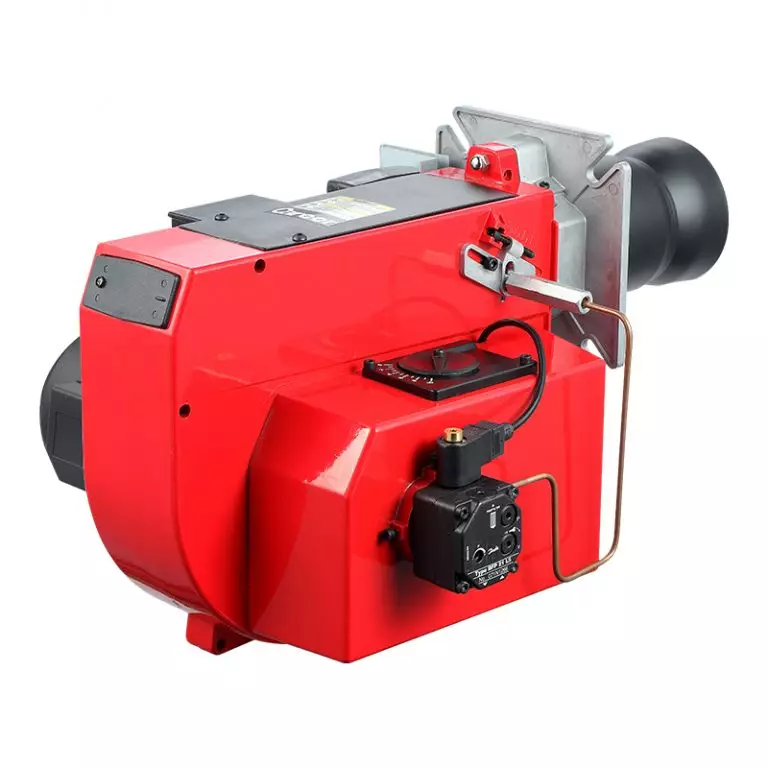
Oil-burner efficiency can decline gradually without an obvious equipment failure. A partially restricted filter, worn nozzle, incorrect air setting, or poorly maintained ignition system may still allow a burner to operate while forcing it to consume more fuel for the same useful heat. Regular maintenance therefore protects efficiency by keeping combustion conditions close to their intended operating point.
Efficiency Starts With Stable Fuel Delivery
Fuel delivery is the first link between maintenance and combustion efficiency. Light-oil burners depend on a consistent supply of clean, filtered fuel. Restrictions in the fuel path can interfere with the burner’s ability to deliver the required quantity and pressure.
Career Burner specifically recommends operating oil burners with clean, filtered fuel and maintaining the correct air-to-fuel ratio. Its product information also states that oil-burner filters should be cleaned or replaced every 3–6 months depending on usage.
A clogged filter does not necessarily stop combustion immediately. Instead, deteriorating fuel delivery can contribute to unstable operation, making the burner work outside its intended conditions. Scheduled filter inspection can therefore prevent a small restriction from becoming an efficiency problem.
Atomization Determines How Completely Fuel Burns
Liquid fuel must be properly atomized before it can mix effectively with combustion air. The nozzle is consequently one of the components that deserves close attention during servicing.
Dirt, deposits, wear, or incorrect nozzle selection can change the spray pattern. Poor atomization can produce an uneven flame and prevent the available fuel from mixing optimally with air. More fuel does not automatically produce more useful heat if combustion quality has deteriorated.
A high efficiency oil burner should therefore be maintained according to the manufacturer’s specified fuel and burner settings rather than simply operated until a fault appears. Nozzle condition, fuel cleanliness, and combustion adjustment work together to determine whether the burner can convert fuel into useful thermal energy efficiently.
Air Settings Can Turn Maintenance Into Energy Savings
Combustion requires an appropriate balance between fuel and air. Too little air can contribute to incomplete combustion, while excessive air can carry unnecessary heat away with the exhaust gases.
Air adjustment should consequently be checked during burner servicing, particularly after components have been replaced or operating conditions have changed. Career Burner identifies low excess air and high combustion efficiency among the characteristics to look for when selecting an efficient oil burner.
For an industrial burner oil installation, maintenance should therefore include verification of combustion settings rather than focusing only on mechanical cleaning. Correct adjustment helps the burner operate closer to its designed combustion conditions and avoids treating increased fuel consumption as an unavoidable operating cost.
Ignition and Combustion Stability Matter
A burner that starts reliably and maintains a stable flame does more than improve operational continuity. Stable ignition also supports consistent combustion from the beginning of each firing cycle.
Inspection should cover ignition components, flame detection, burner-head condition, and relevant safety controls. Career Burner advises that built-in safety devices should never be bypassed and that manufacturer settings for temperature, pressure, and safety controls should be followed.
Poor combustion stability can indicate a deeper issue rather than a simple ignition fault. Fuel delivery, nozzle condition, air adjustment, and burner components should be assessed together instead of replacing one part without identifying the underlying cause.
Controls Keep the Burner Matched to Demand
Efficiency is also influenced by how closely burner output follows the actual thermal requirement. A system that repeatedly operates at an unnecessarily high firing rate can waste energy even when combustion itself is technically sound.
Career Burner’s oil-burner collection includes single-stage, two-stage, on-off, and modulation-control configurations. Such control options provide different ways to regulate firing according to system requirements.
Maintenance should verify that these controls continue to operate correctly. A malfunctioning actuator, sensor, or control setting can prevent the burner from responding properly to changing demand. Keeping regulation equipment functional can therefore protect efficiency without changing the fundamental heating system.
Maintenance Should Follow the Source of Efficiency Loss
Effective servicing is not simply a matter of cleaning the burner on a fixed schedule. Maintenance should target the components that influence fuel delivery, atomization, air supply, ignition, and firing control.
Career Burner’s product range covers light-oil equipment using diesel, kerosene, and Bio 10 oil, with stated outputs ranging from 24 kW to 1,416 kW. Its published guidance emphasizes regular maintenance, correct air-to-fuel adjustment, clean fuel, and compliance with manufacturer settings.
For operators, the practical lesson is straightforward: maintenance protects efficiency by preserving combustion conditions. A neglected burner can continue producing heat while gradually consuming more fuel than necessary. A well-maintained system keeps fuel delivery, atomization, air supply, ignition, and controls working together.
Career Burner positions its oil-burner range around energy efficiency and stable combustion for industrial and commercial applications. The maintenance strategy should support those operating characteristics throughout the equipment’s service life.
Regular inspection is therefore an energy-management activity, not merely a reliability task. When maintenance addresses the actual causes of combustion deterioration, an industrial burner oil system has a better chance of maintaining consistent heat output without unnecessary fuel consumption. A properly maintained high efficiency oil burner can preserve the combustion performance that the system was designed to achieve.